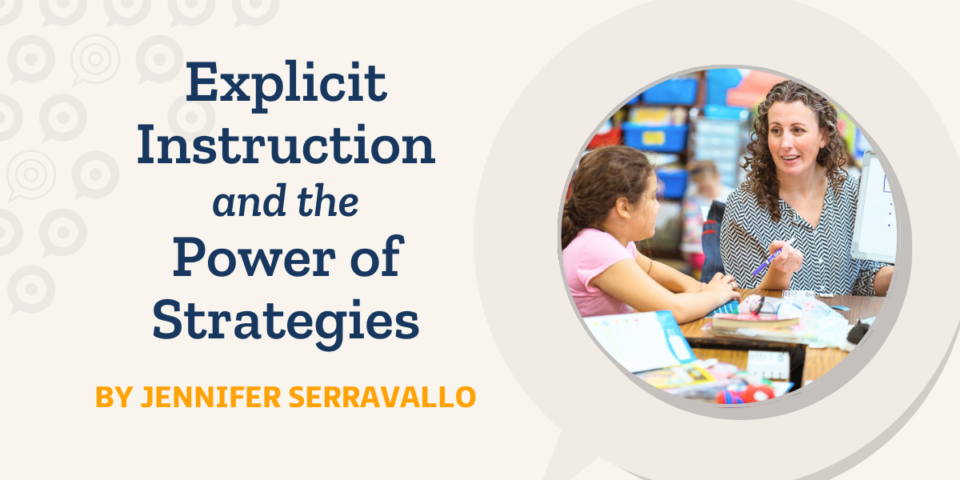
Think about the best lesson you've ever taught. It seemed effortless, but it required intention and clarity. You deliberately planned how to introduce new skills, how to model them, and how to guide students toward mastery. These are elements of explicit instruction, and it's one of the most powerful approaches we have.
Explicit instruction hinges on engagement.
Explicit instruction isn't just about what the teacher does; it's equally about what students do. During lessons, students should be highly engaged and active, not passive recipients of information. And critically, the teacher must remain responsive throughout: reading the room, listening and observing, checking for understanding, and adjusting plans as necessary to help every student move toward the learning target.
Explicit instruction is purposeful, transparent, and adaptive. It shows students not just what to do, but how and why. And that’s where strategies come in.
Strategies turn skills into steps.
A strategy helps make any reading or writing goal or skill doable by breaking it down into clear, actionable steps that guide students through the process. Strategies are temporary scaffolds. Once a strategy becomes automatic, the mental effort once needed to work through each step quietly recedes. But that knowledge of those steps doesn't disappear. Strategies are powerful learning tools that students can resurrect whenever they encounter challenge.
Explicit teaching and strategies are a natural match.
Explicit instruction works because it reduces cognitive load. When you break content into clear steps, model your thinking out loud, and build on what students already know, you help them move new information from working memory into long-term memory, where it sticks.
Strategies do the same thing for students. They take something complex and abstract and make it manageable and actionable. Students can follow clear steps, which frees up mental energy for them to think about the content. The research is clear: strategy instruction works for all students, regardless of grade-level, socioeconomic background, or learning ability. And students who learn to use strategies become more self-regulated, which enhances both learning and performance.
Strategies are a critical component of the nine Elements of Engaging, Explicit Instruction.
Strategies aren't a separate add-on to the nine Elements of Engaging, Explicit Instruction (Serravallo, 2024)—they're woven throughout each one. Here's how they connect:
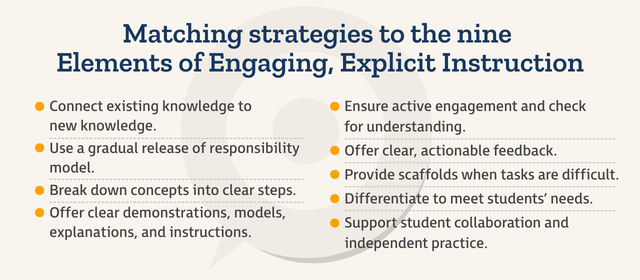
- Connect existing knowledge to new knowledge. Strategies give students a concrete way to activate what they already know before tackling something new.
- Use a gradual release of responsibility model. Strategies are perfect vehicles for the I do / We do / You do arc. The steps of the strategy stay consistent across each phase — what changes is how much support surrounds them.
- Break down concepts into clear steps. A strategy breaks down an abstract skill into a sequence students can follow. The steps are the scaffold.
- Offer clear demonstrations, models, explanations, and instructions. When you think aloud using a strategy, your explanation becomes concrete and repeatable. Students aren't just watching you read—they're watching you work through specific steps they can replicate.
- Ensure active engagement and check for understanding. Strategies give students something tangible to do during practice. When you check for understanding, you can watch students apply specific steps, which tells you far more than a hand raise ever could.
- Offer clear, actionable feedback. Strategies make feedback precise. Instead of "try again," you can point a student to a specific step. That precision makes feedback land. Students know exactly what to adjust.
- Provide scaffolds when tasks are difficult. Strategies are scaffolds. They give students just enough structure to access challenging work and are designed to fade as students grow more confident and capable.
- Differentiate to meet students’ needs. Having a range of strategies means you can match the right tool to the right learner at the right moment.
- Support student collaboration and independent practice. Strategies give students a shared language and process to use whether working with peers or on their own. Over time, consistent practice with strategies moves skills toward automaticity.
Explicit instruction, done well, is not rigid—it is a framework for making every lesson as efficient and effective as possible. And strategies are what give that framework its teeth. Of course, explicit teaching is more than strategies alone. It's about knowing your students, building on what they know, staying responsive in the moment, and creating conditions where every learner can succeed. But strategies are one of the most practical and powerful tools in that work. They transform abstract principles into concrete actions, reduce cognitive load by breaking skills into steps, provide scaffolds that support independence, and give teachers precise language for modeling, feedback, and coaching.
When teachers select strategies purposefully—matching them to student goals and needs, modeling them clearly, and releasing responsibility over time—they are practicing explicit instruction at its best. The ultimate measure of success is not whether students can name a strategy, but whether they have internalized its steps so fully that they no longer need it at all.
If you're looking for a place to start, check out Jennifer Serravallo’s The Reading Strategies Book 2.0 and The Writing Strategies Book which include more than 600 strategies across both reading and writing organized by goal, so you can find the right strategy for the right student at the right moment.

Jennifer Serravallo is the author ofThe New York Times' bestselling The Reading Strategies Book 2.0 and The Writing Strategies Book. These and some of her other titles have been translated into Spanish, French, Italian, and Chinese. Her popular books and resources help teachers make goal-directed, responsive, explicit strategy instruction doable in every classroom. Her newest titles are The Reading Strategies Book 2.0; Teaching Writing in Small Groups; A Teacher’s Guide to Reading Conferences, and the assessment and teaching resource Complete Comprehension for Fiction and Nonfiction.
Jen is a frequently invited speaker at national and regional conferences. She and her team of literacy specialists travel throughout the US and Canada to provide full-day workshops and to work with teachers and students in classrooms. She and her team are also experienced online educators who regularly offer live webinar series and full-day online workshops.
Jen began her career in education as an NYC public school teacher. Now as a consultant, she has spent the last twenty+ years helping teachers across the country create literacy classrooms where students are joyfully engaged, and the instruction is meaningfully individualized to students' goals. Jen served as a member of Parents Magazine Board of Advisors for education and literacy, and is on the NYC Reads Advisory Council as the city works to bring Science of Reading, Writing, and Learning-based practices to every classroom.
Jen holds a BA from Vassar College and an MA from Teachers College, where she has also taught graduate and undergraduate classes.
Learn more about Jen and her work at Hein.pub/serravallo, on Twitter @jserravallo, or Instagram @jenniferserravallo.