Adapted from Carla Dabau Padrosa's Designing Intentional Classrooms.
As teachers, we’re asked to meet the diverse needs of large classes, often with limited resources and tight budgets. This work can feel overwhelming, but it’s also the heart of what makes teaching such a powerful profession. When both students and teachers feel valued for who they are, the entire classroom benefits: students become more engaged, happier, and more respectful while teachers feel supported, respected, and less stressed.
For school leaders, creating that supportive environment for teachers is critical to both their success and the overall culture of the school. When teachers feel like they belong, that they’re safe, and that their leaders genuinely understand them, they’re in a much better place to offer that same kind of care to their students. Taking care of teachers’ mental health and well-being, whether through meaningful professional development, self-care resources, or intentionally designed spaces, can noticeably shift the culture of a school. And when that culture lifts teachers up, they’re able to show up fully for their students every day. Classroom design and emotional safety are not “extras”; they’re essential tools for preventing burnout and retaining passionate educators. When classroom spaces are ignored, teachers feel unseen, unsupported, and mentally exhausted.
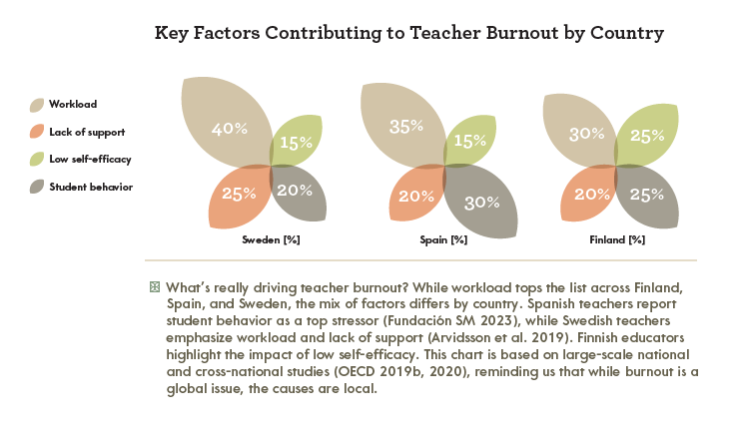
Research validates the need to redesign environments not only for the benefit of students but also as a core strategy for protecting teacher mental health and school culture. According to surveys by Gallup (Marken and Agrawal 2022) and RAND Corporation (Steiner et al. 2022), teacher burnout in the United States surged to over 50 percent by 2022, especially during and after the COVID-19 pandemic. Contributing factors include increased workloads, emotional exhaustion, and lack of systemic support.
Similarly, reports from the OECD’s TALIS surveys (2014, 2019b, 2020) and national well-being studies (Fundación SM 2023; NRO 2022) show teacher burnout in Spain and the Netherlands growing steadily due to classroom management stress, lack of planning time, and poor spatial conditions.
Finally, while Finland consistently shows lower burnout rates among teachers, recent studies—including from the Finnish Institute for Health and Welfare (THL) (2021)—highlight a gradual increase linked to teacher workload intensification, though mitigated somewhat by strong support systems and flexible space design.
After years of work in schools, conversations with teachers, and informal feedback during workshops, I consistently hear three recurring challenges: a poor physical environment, heavy workload, and lack of administrative support. Notice how these factors often show up together, compounding the pressures teachers feel daily. And these patterns are not just anecdotal, research confirms them. Magtalas and Eduvala (2024) found that teachers reporting high work and role overload experienced significantly higher levels of burnout and reduced job satisfaction. Similarly, Greenglass and Burke (2003) showed that a perceived lack of administrative support was strongly linked to teacher stress and burnout. These overlapping stressors create environments that can wear teachers down over time, unless intentionally addressed.
Building a classroom that’s inclusive and welcoming doesn’t mean you need to make a million changes all at once. It can start small with thoughtful, intentional tweaks. Every little step moves you closer to a space that feels warm, open, and like you. Teacher Maria Ballester put it perfectly when she described the classroom as an extension of the teacher’s values and what they want to share with the world.
When you think about it that way, every choice you make—what you hang on the walls, how you arrange the seats, even the little cultural touches you add—becomes a chance to reflect your vision and make the classroom a place where everyone belongs. You included.