Adapted from Wendy Ward Hoffer’s All Minds on Mathematics.
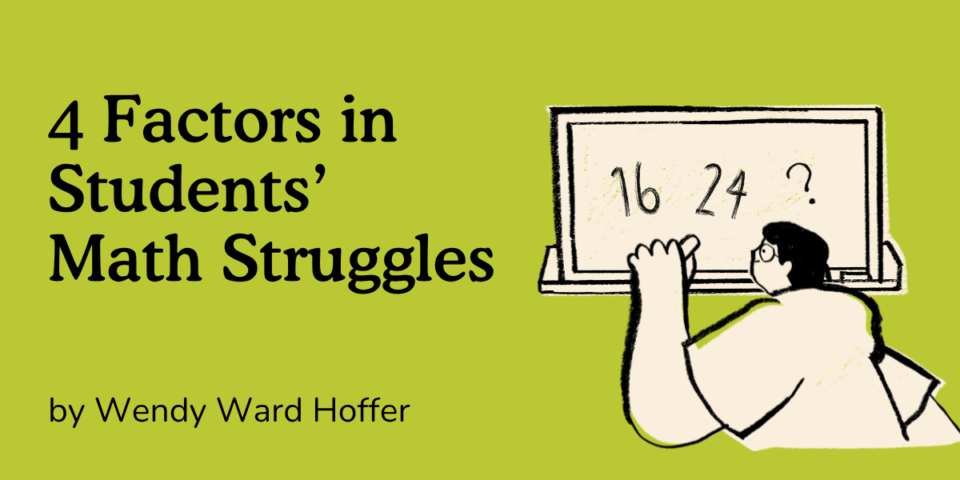
We can’t learn when we are stressed out any more than we can text with our cell phones turned off. What we as teachers may perceive as students’ inattention, lack of motivation, hyperactivity, or low intelligence may in fact be a stress response, which, if we understand and address it, can be ameliorated or healed. When we invest in the emotional safety of our students—by seeing them as the uniquely gifted and capable individuals that they are—treating them as such, teaching them to regard themselves as powerful mathematically and beyond, we create a setting where each student can thrive. This begins with an awareness of some factors that maybe diminishing their sense of ease in math as well as in life more generally:
- math anxiety,
- bias,
- stereotypes, and
- stereotype threat
Unfortunately, many young people experience high levels of fear, anxiety, and trauma—some related to math learning, and many more as a result of current or historical stressful events affecting their lives, which can interfere with their brains’ capacity to think and integrate new information. Some students find school as a place of solace, providing social interaction, and routine or predictability they may lack at home. Math class itself might offer a logical, creative, orderly setting for some young people struggling with chaos in other areas of their lives. And yet, for too many, math triggers distress, which causes the brain to opt out rather than to engage in mathematical sense-making (Sousa 2022). In addition to the challenges of the content itself, bias and stereotypes about certain math students, as well as stressful life circumstances and traumatic experiences within or beyond the classroom can limit learners’ access to their own higher-order thinking, waste learning time, and create negative attitudes toward school.
Math Anxiety
As described by Stanford mathematics professor Dr. Jo Boaler, math itself can cause students to feel unsafe. Many traditional modes of instruction in math classes—timed tests, pop quizzes, and cold calling on students—amplify that sense of anxiety. When we emphasize correctness over thinking processes, we perpetuate the idea that some of us “get” math and others don’t. And when we focus on procedures and speed, then load on homework, Boaler writes, math anxiety skyrockets even more, creating additional barriers to learning (Boaler 2017).
A study of math anxiety by University of Chicago psychology scholars Erin Maloney, Marjorie Schaeffer, and Sian Beilock quotes a 10-year-old student writing about her experiences:
| Math. I hate math. It makes me feel all wiggly inside. During the [high stakes test] last year, I thought I was going to throw up when we did the math part. I didn’t, but I always feel that way even when we just line up for math class. (2013, 115) |
Math anxiety may be triggered by learner confusion, limited math background knowledge, internalized stereotypes, past math learning experiences, or other factors.
Historical Performance
Students’ personal histories in a content area can impact how they respond to new learning. As described by neuroscientist David Sousa in How the Brain Learns:
| [I]f past experiences produced failure, then the sensory register is likely to block the incoming data, just as Venetian blinds are closed to block light. The learner resists being part of the unwanted learning experience and resorts to some other cerebral activity, internal or external, to avoid the situation. In effect, the learner’s self-concept has closed off the receptivity to the new information. (2022, 104) |
With this awareness, as educators we need to be mindful of learners’ identities as mathematicians, the ways in which we create safety and support their openness toward the content and find inroads to connect their interests to the subject at hand.
Stereotypes
While efforts toward representation in the news media are growing, we still live in a society that promotes the myth of a “math gene,” and forgives well-educated folks—especially women—for the disclaimer, “I am just not a math person.” Stereotypes and biases can be held by teachers or students and, if not addressed, seep into the culture of the classroom in subtle ways. A teacher might call on the white kids first, for example. Another might hand the materials out to the boys in each group to distribute. Meanwhile, a well-intended veteran teacher may invite native English speakers to present on behalf of teams with students from mixed language backgrounds. These are all examples of microaggressions—small, subtle acts of bias—that undermine the confidence and limit the participation of the historically underserved students.
As cited in Learning to Teach for Social Justice (Darling-Hammond et al. 2002, 50), researcher Kristin Traudt surveyed students of diverse backgrounds about how their teachers’ cultural and ethnic identities impacted the students. Students indicated that, “It is more important that teachers respect and value them as individuals than that they be of the same race as the students . . .” As one student shared, “Diversity shouldn’t necessarily matter between teacher and student relationship, but it does. I would feel more comfortable with a teacher who understood me. It does not have to exactly be by ethnicity, but more by actions.”
Stereotype Threat
Beyond the impact of stereotypes themselves, stereotype threat is the result of individuals internalizing and then performing in alignment with a known stereotype (even if a teacher is doing everything to consciously reject a bias). Stereotype threat is described as a “socially premised psychological threat that arises when one is in a situation or doing something for which a negative stereotype about one’s group applies” (Steele and Aronson 1995). Psychology researcher Jason Osborne (2007) illustrated this to be especially true among both female and Black students. When girls were reminded of a “math is for boys” stereotype immediately before an assessment, their scores trailed boys’ by a significant margin. But when that stereotype was not presented, the girls outscored the boys. Similarly, when Black college students took a math exam without a reminder of a Black versus white achievement gap, the Black students outscored the white ones. But when the stereotype was introduced to another group of students before their exam, the white students scored far higher, and scores of Black students fell. These tests illustrated less about students’ capacity in mathematics and more about their tendency to perform in alignment with social expectations.